Thursday, 19 March 2015

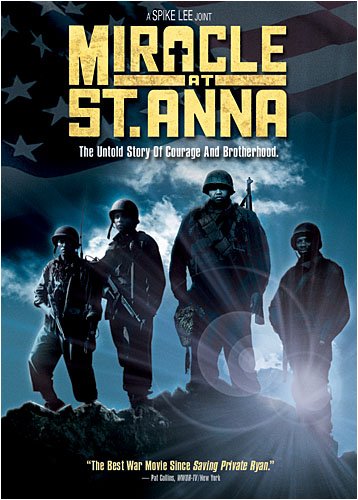
American Comparative study: Miracle at St. Anna & Inglorious Bastards

Both Inglorious Bastards and Miracle at St. Anna are WW2 films and follow a group of soldiers, not often represented in today’s film industry. The WW2 action film Genre is an oversaturated market but Inglorious Bastards and Miracle at St. Anna differ from the norm due to their perspective. Miracle at St. Anna is told from the perspective of a platoon of black soldiers, this an uncommon perspective for WW2 films, though it follows the conventions of the director Spike lee whose films are often told from a black perspective. Inglorious Bastards is told from the perspective of a group of Jewish soldiers in Germany who use fear and intimidation to fight fire with fire.


Both groups within the films are an oppressed minority, in Miracle at St. Anna the black soldiers are thought of as very little by their white commander who has no problems shelling their position, not believing that they are capable of getting across the river which for all intents and purposes was a suicide mission which is why the black soldiers were sent first.

The story telling of both films is different in the sense that neither has a conventional way of telling their narrative. Miracle at St. Anna uses many flashbacks, and the main course of the film is set during one of these flashbacks. Inglorious Bastards tells two stories concurrently, it also used flashbacks and flash forwards, although to a lesser degree. The films differ in their presentation; one could argue that Inglorious Bastards uses a large amount of Black humour in order to tell the story, whereas the only comedic relief in Miracle at St. Anna is the slightly slow soldier who looks after the boy.


In conclusion Miracle at St. Anna share many similarities with Inglorious bastards in its themes of an oppressed minority refusing to be victims despite their often desperate situation.  

Monday, 16 March 2015

Film Reflective Analysis


For my film the initial idea was different from the outcome, my original aim of the film I found required to wide a variety of locations and props to be an enjoyable and realistic presentation of what I outlined in my proposal, I felt that I did not have the necessary resources to faithfully depict my idea and so instead I opted to change it. My second idea differed greatly from my original proposal, although some similarities can be found in the themes. When planning my new idea I took into account more closely the resources at my disposal and made judgements based on what I could accurately achieve. Once I settled on the current idea, I was fortunate enough to already have a location that fitted the vision of what I was trying to detail, when I was originally thinking up the idea I decided an older grizzled looking man would be appropriate, but finding someone matching that description proved difficult and in the end I settled on my own Grandmother who also had a good location in which to present the idea of an older person who is shut away from the world as my Grandmother’s house is rather old and the interior is exactly what I had in mind when deciding where to shoot the opening portion of my Film.

To begin with I began the shooting at night, the location of where I was shooting had a small fireplace which I used to create a more natural looking light rather than the harsh orange like glow that you can often get with an artificial light like a lamp. I felt this idea helped with the presentation of the scene as it left a lot of the room dark and obscured which led to a sense of mystery in the viewers who have seen the film. On the first day of shooting I shot the indoor scenes at night but as I made my way outside I again was faced with the realisation that I could not adequately shoot good shots in such low light, especially as most of the outdoor shots were set in Rural areas where there is no lights from streetlamps of other houses. I decided to keep the indoor scenes that I filmed that day and implement it into my final edit as I felt that the dark helped with the idea that the lady was a shut in and had her curtains drawn to allow for as little light as possible. When I came back to shoot during the daylight though the light cast into the room was far too bright and made the scenes I filmed during the night look unrealistic, to combat this I had to cover some windows and turn off the lights. This made it look good enough that people couldn’t tell without prior knowledge.

The next issue I had was making the shots of walking through the woods match up properly as they were filmed at different locations; I had to edit it in a way where it seemed progressive when in fact it was not. You could tell it was not progressive in the shot down the muddy track but at that point I decided that the audience would assume it was a time later as I felt if I was to show the whole journey it would become monotonous and wasn’t entirely necessary as those shots were the just to established the fact that it was a rather arduous journey for someone who does not leave the house often, to accentuate the difficulty I got my Grandmother (Who was playing the old woman) to appear more hunched and have a more laboured gait than would naturally come to her, I felt she did a good job given her limited experience with acting although in the final scenes I decided to cut out the part where she speaks as the sound wasn’t right and she couldn’t quite match the tone I was looking for, what she was saying mattered less as she was speaking Italian but overlook her tone and opted instead just to remove the scene.

In conclusion despite the difficulty in getting the right locations and having the correct resources I overcame this by adapting my idea to the constraints I had, I felt I handled It well and still managed to come up with a competent film that was close enough to my idea.  

Saturday, 14 March 2015

Analysis Sheet - My Brother the Devil, Fish Tank, & The Selfish Giant

My Brother the Devil 


Title: My Brother the Devil
Director: Sally El Hosaini
Writer: Sally El Hosaini
Producer: Julia Godzinskaya

Production Company: Rooks Nest Entertainment, Wild Horses Film Company, Film-Clinic, Blood Brothers Films
Budget:
Box Office: £806,386
Cast:
James Floyd- Rashid
Fady Elsayed- Mo
Anthony Welsh- Izzi
Amira Ghazalla- Hanan
Nasser Memarzia- Abdul-Aziz
Saïd Taghmaoui– Sayid
Genre: Social Realism, Crime, Drama

Themes: Identity, Living with crime, secrecy, Love
Year: 9th November 2012


Fish Tank


Title: Fish Tank

Director: Andrea Arnold
Writer: Andrea Arnold
Producer: Kees Kasander

Production Company: BBC Films, UK Film Council
Budget: £1.8M
Box Office: £1.5M
Cast: Katie Jarvis -Mia
Michael Fassbender - Connor
Kierston Wareing - Joanne
Rebecca Griffith- Tyler
Genre: Social Realism, Drama, Crime

Themes: Living with Crime, Hope, isolation,
Year: 11 September 2009

The Selfish Giant


Title: Selfish Giant

Director: Clio Barnard
Writer: Clio Barnard, Oscar Wilde ( Inspired)

Producer:
Production Company: British Film Institute, Film4, Moonspun Films
Budget:

Box Office: £633,578
Cast:
Conner Chapman- Arbor
Shaun Thomas         - Swifty
Sean Gilder- Kitten
Genre: Drama, Crime

Themes: Friendship, Living with crime, Fear,
Year: 2013


Analysis Sheet - Inglorious Bastards & Miracle at St. Anna


Inglorious Bastards

Title: Inglorious Bastards
Director: Quentin Tarantino, Eli Roth ( Uncredited)
Writer: Quentin Tarantino
Producer: Lawrence Bender
Production Company: A Band Apart, Studio Babelsberg
Budget: £50,395,944
Box Office: £80,988,253
Cast: Brad Pit- Lt. Aldo Raine
Mélanie Laurent- Shosanna
Christoph Waltz       - Col. Hans Landa
Eli Roth- Sgt. Donny Donowitz
Michael Fassbender- Lt. Archie Hicox
Genre: WW2, Action, Dark Humour

Themes: History, Tyranny, Camaraderie
Year: 2009


Miracle at St. Anna


Title: Miracle at St. Anna
Director: Spike Lee
Writer: James McBride
Producer: Spike Lee

Production Company: 40 Acres and a Mule
Budget: £30,226,701
Box Office: £5,319,291
Cast:
Derek Luke- 2nd Staff Sergeant Aubrey Stamps
Michael Ealy- Sergeant Bishop Cummings
Laz Alonso- Corporal Hector Negron
Omar Benson Miller- Private First Class Sam Train
Pierfrancesco Favino- Peppi 'The Great Butterfly' Grotta
Valentina Cervi- Renata
Genre: WW2, War, Action

Themes: History, Betrayal, love, Hopelessness
Year: 2008

Tuesday, 10 March 2015

Revision Schedule

Monday
American Films, Miracle at St. Anna Inglorious Bastards

Tuesday
British Films, My Brother the Devil, Selfish Giant, Fish tank
Wednesday
Comparison Practice
Thursday
Past Exam Question
Friday
Film Industry
Saturday
Past Exam Question
Sunday
Social Media

Thursday, 22 January 2015

Rain Man Airport Scene: Analysis of Editing and Performance. REV 1

The scene opens with a wide shot of Raymond, he is sitting in a chair watching television. The director uses a wide shot to establish the scene and show the current location, the audio is that of Charlie talking with one of his employees. The camera then moves to an over the shoulder shot from Raymond’s perspective, we see him watching the television on a little screen on his chair and in the background we see Charlie standing by a pay phone, arguing with his employee; telling him to be more forceful with the clients. The camera then changes to a close up of Charlie on the phone; his brow is furrowed and he looks distressed as he continues to argue. It switched to another over the shoulder shot but this time from the perspective of Charlie, the camera faces towards Raymond as Charlie covers his face with his palm, Raymond on the other hand is calm as he sits there peacefully. This is a clever juxtaposition as we see Charlie clearly exasperated at the situation and Ray calmly sitting there unaware of the situation but perfectly content to just sit there.
From there it switches to another wide shot as Charlie puts down the phone and picks up his bag.  Ray meanwhile is still calmly sitting there watching the television, the camera does not follow Charlie as he walks towards Ray and begins to click his fingers to get his attention, the camera then cuts in with a focus of Ray as Charlie continues to attempt to get his attention until finally Ray  jumps having noticed Charlie. It isn’t until Charlie pulls Ray’s bag that he gets to his feet, the Camera transitioning to a wide shot as both characters walk off frame. All the while Charlie is asking Ray what he is watching and Ray responds familiarly with “I don’t know”. The next shot is another wide shot from behind the subjects as they walk towards their gate. Ray’s bag between them as he is almost pulled along by his brother; this is clever because it shows that at this point of the film Charlie thinks little of Ray; treating him almost like a dog as he pulls him about and clicks his fingers at him. At this point Charlie doesn’t seem to see him as a person yet but rather keeps him with him due to necessity and treats him poorly as a result.

The next shot is a close up of Ray as he is being pulled along by Charlie, he  bends down for a moment as he sees the aeroplanes, he displays a worried expression as he exclaims “Oh, oh”, stating that there is an airplane out there. The camera then transitions to a two shot of the pair as Ray worriedly exclaims his disdain for aeroplanes, and Charlie attempts to coax him into getting on one. The director uses this shot for the scene as he is trying to show us the contrasting emotions on the subject’s faces, one a look of exasperation and the other a look of panic. There is then a long sequence of dialogue as Ray tells Charlie about a list of airline accidents all the while trying to explain to him why he will not get on a plane. The next shot is a close up of Ray’s face as he is being pulled by Charlie, he looks scared. Charlie then comes into frame as he questions Ray about his specific objections. The shot then changes to another wide shot facing Charlie’s back but showing Ray; the camera follows Charlie as he moves over to the flight information board and begins telling Ray about the various flights, only to be interrupted by Ray with various crash information. The Camera focuses on Ray with a close up as he tells Charlie about the crashes, his face contorted with worry. The next shot is of Charlie who is staring at Ray, his face a look of calm annoyance at his brother’s supposed ineptitude at doing common and every day things. As Charlie turns back towards the flight information board there is a cut in of the boards showing us a list of the flights. During the close up of the screens showing the flights Charlie starts listing flights, his voice has clear annoyed tone to it. The actor does this during the performance to show us that he is annoyed yet he does not seem angry. Tom cruise, who plays Charlie does a good job at making the Character of Charlie seem not wholly bad. He plays him as an impatient but perhaps selfish man who cares only for himself; this is exemplified during this seen as despite Raymond’s clear objections to flying he insists on doing it anyway. Although he has some redeeming qualities and the character development is well done as nearing the end of the film despite little difference in Raymond’s affection towards him Charlie Begins to love his brother and care for his interests instead of his own, seeing him more like a person and less like an animal.
After Charlie lists a flight for American Airlines, the camera cuts to a close up of Ray’s worried looking face as he lists the reason they should not get on that flight as an American Airlines plane had crashed before, The shot then changes to a close up of Charlie’s face as he stares at his brother. In this instance he does not seem annoyed and instead offers and alternative, looking back at the Board he quickly sees a Continental flight and rushes off towards the gate, possibly in hopes that he could move to quickly, leaving Raymond no time to reject the flight. As Raymond enters the frame the camera stills follows the moving Charlie despite, Raymond being the one who begins dialogue, the director chose to do this to show that this particular shot is focused on Charlie as he rushes off, it helps us know who the subject is at the time and also show us that Charlie is trying to ignore Raymond’s protests. Raymond Begins telling Charlie about a Crash that has happened, Charlie continues walking for a second before turning about and facing Raymond, he sighs heavily and his face looks annoyed now. Raymond does not look Charlie in the eye, this is a common theme through the film that is linked to his autism yet in this particular instance it is done because he is nervous and also perhaps is weary of his brother growing annoyance to his objections. The character that Dustin Hoffman plays is done so well that he won an Oscar for best Actor in a leading Role in 1989. This could be attributed to the well done research into autism and those with Savant skills; specifically the character of Raymond is based off a real life “Megasavant” named Kim Peek, Hoffman’s performance takes into account of Peek’s mannerisms. He learned this during meeting with Peek and developed this into the character, everything from his speech pattern to his posture. It is likely this research that gained Hoffman the Oscar as his performance so closely mirrors that of a real life counterpart.
After stopping and sighing at Raymond, Charlie attempts to reason with him. Though at this point in the narrative Charlie doesn’t fully understand Raymond’s strengths and limitations. During this monologue where Charlie try’s to appeal to Ray by explaining his precarious situation, Ray continue to not maintain eye contact and stare vacantly ahead, this shows us that Raymond does not care. Not because of any selfish desire on his own part, but more so due to his lack of ability to reason and see another person’s perspective. During the monologue Charlie becomes increasingly exasperated and takes on a more forceful tone, almost commanding Ray to get on the plane; despite the fact that the stern nature of his tone has no effect on Ray as he does not understand human emotions well enough, I think the director uses this shot to illustrate that and continue to help paint a picture for the audience by telling us his limitations and help us understand the situation from Raymond’s perspective.
Charlie continues his Monologue as he lists other planes they may take, with brief rebuttals telling Charlie information about when a certain plane has crashed and what were the casualties. As the situation becomes increasingly more heated, we can see that Ray becomes more visibly agitated. He begins to rock on back and forth on his heels and briefly touch his neck; this performance helps strengthen the overall image of Ray, and his autism. The acting is cleverly done as Dustin Hoffman uses these subtle nuances like touching his neck and rocking back and forth to help sell his overall performance as a man with autism, whilst using little dialogue. This also foreshadows the part later in the scene when all the stress of the situation causes him to have a fit; the actor uses these little gestures to show us the build-up of stress, without verbally telling us.
As the section continues we can see Charlie’s increasing annoyance through his voice which becomes more stern and loud, this is a good contrast that shows us the difference between how someone with autism may be getting agitated but would struggle showing that to us with words yet it is their body language that would indicate this. And how Charlie shows his agitation through a more normal method of raising his voice. This build-up of Stress and annoyance by both parties comes out in different ways, Charlie attempts to force Raymond onto the plane by dragging him, much like a pet owner would a disobedient dog. This causes Raymond to go into a fit causing him to begin hitting himself and screaming loudly. This is of course not a normal reaction but it is these kind of nuances in Dustin Hoffman’s performance that make Raymond such a believable character, he reacts how someone with autism might and does it convincingly.
In conclusion I believe that during this scene the director has used subtlety used editing to help with the actors stellar performance, it is a combination of these two micro -features that make the scene as stellar as it is.       

Thursday, 15 January 2015

Rain Man Airport Scene: Analysis of Editing and Performance

The scene opens with a wide shot of Raymond, he is sitting in a chair watching television. The director uses a wide shot to establish the scene and show the current location, the audio is that of Charlie talking with one of his employees. The camera then moves to an over the shoulder shot from Raymond’s perspective, we see him watching the television on a little screen on his chair and in the background we see Charlie standing by a pay phone, arguing with his employee; telling him to be more forceful with the clients. The camera then changes to a close up of Charlie on the phone; his brow is furrowed and he looks distressed as he continues to argue. It switched to another over the shoulder shot but this time from the perspective of Charlie, the camera faces towards Raymond as Charlie covers his face with his palm, Raymond on the other hand is calm as he sits there peacefully. This is a clever juxtaposition as we see Charlie clearly exasperated at the situation and Ray calmly sitting there unaware of the situation but perfectly content to just sit there.
From there it switches to another wide shot as Charlie puts down the phone and picks up his bag.  Ray meanwhile is still calmly sitting there watching the television, the camera does not follow Charlie as he walks towards Ray and begins to click his fingers to get his attention, the camera then cuts in with a focus of Ray as Charlie continues to attempt to get his attention until finally Ray  jumps having noticed Charlie. It isn’t until Charlie pulls Ray’s bag that he gets to his feet, the Camera transitioning to a wide shot as both characters walk off frame. All the while Charlie is asking Ray what he is watching and Ray responds familiarly with “I don’t know”. The next shot is another wide shot from behind the subjects as they walk towards their gate. Ray’s bag between them as he is almost pulled along by his brother; this is clever because it shows that at this point of the film Charlie thinks little of Ray; treating him almost like a dog as he pulls him about and clicks his fingers at him. At this point Charlie doesn’t seem to see him as a person yet but rather keeps him with him due to necessity and treats him poorly as a result.

The next shot is a close up of Ray as he is being pulled along by Charlie, he  bends down for a moment as he sees the aeroplanes, he displays a worried expression as he exclaims “Oh, oh”, stating that there is an airplane out there. The camera then transitions to a two shot of the pair as Ray worriedly exclaims his disdain for aeroplanes, and Charlie attempts to coax him into getting on one. The director uses this shot for the scene as he is trying to show us the contrasting emotions on the subject’s faces, one a look of exasperation and the other a look of panic. There is then a long sequence of dialogue as Ray tells Charlie about a list of airline accidents all the while trying to explain to him why he will not get on a plane. The next shot is a close up of Ray’s face as he is being pulled by Charlie, he looks scared. Charlie then comes into frame as he questions Ray about his specific objections. The shot then changes to another wide shot facing Charlie’s back but showing Ray; the camera follows Charlie as he moves over to the flight information board and begins telling Ray about the various flights, only to be interrupted by Ray with various crash information. The Camera focuses on Ray with a close up as he tells Charlie about the crashes, his face contorted with worry. The next shot is of Charlie who is staring at Ray, his face a look of calm annoyance at his brother’s supposed ineptitude at doing common and every day things. As Charlie turns back towards the flight information board there is a cut in of the boards showing us a list of the flights. During the close up of the screens showing the flights Charlie starts listing flights, his voice has clear annoyed tone to it. The actor does this during the performance to show us that he is annoyed yet he does not seem angry. Tom cruise, who plays Charlie does a good job at making the Character of Charlie seem not wholly bad. He plays him as an impatient but perhaps selfish man who cares only for himself; this is exemplified during this seen as despite Raymond’s clear objections to flying he insists on doing it anyway. Although he has some redeeming qualities and the character development is well done as nearing the end of the film despite little difference in Raymond’s affection towards him Charlie Begins to love his brother and care for his interests instead of his own, seeing him more like a person and less like an animal.
After Charlie lists a flight for American Airlines, the camera cuts to a close up of Ray’s worried looking face as he lists the reason they should not get on that flight as an American Airlines plane had crashed before, The shot then changes to a close up of Charlie’s face as he stares at his brother. In this instance he does not seem annoyed and instead offers and alternative, looking back at the Board he quickly sees a Continental flight and rushes off towards the gate, possibly in hopes that he could move to quickly, leaving Raymond no time to reject the flight. As Raymond enters the frame the camera stills follows the moving Charlie despite, Raymond being the one who begins dialogue, the director chose to do this to show that this particular shot is focused on Charlie as he rushes off, it helps us know who the subject is at the time and also show us that Charlie is trying to ignore Raymond’s protests. Raymond Begins telling Charlie about a Crash that has happened, Charlie continues walking for a second before turning about and facing Raymond, he sighs heavily and his face looks annoyed now. Raymond does not look Charlie in the eye, this is a common theme through the film that is linked to his autism yet in this particular instance it is done because he is nervous and also perhaps is weary of his brother growing annoyance to his objections. The character that Dustin Hoffman plays is done so well that he won an Oscar for best Actor in a leading Role in 1989. This could be attributed to the well done research into autism and those with Savant skills; specifically the character of Raymond is based off a real life “Megasavant” named Kim Peek, Hoffman’s performance takes into account of Peek’s mannerisms. He learned this during meeting with Peek and developed this into the character, everything from his speech pattern to his posture. It is likely this research that gained Hoffman the Oscar as his performance so closely mirrors that of a real life counterpart.
After stopping and sighing at Raymond, Charlie attempts to reason with him. Though at this point in the narrative Charlie doesn’t fully understand Raymond’s strengths and limitations. During this monologue where Charlie try’s to appeal to Ray by explaining his precarious situation, Ray continue to not maintain eye contact and stare vacantly ahead, this shows us that Raymond does not care. Not because of any selfish desire on his own part, but more so due to his lack of ability to reason and see another person’s perspective. During the monologue Charlie becomes increasingly exasperated and takes on a more forceful tone, almost commanding Ray to get on the plane; despite the fact that the stern nature of his tone has no effect on Ray as he does not understand human emotions well enough, I think the director uses this shot to illustrate that and continue to help paint a picture for the audience by telling us his limitations and help us understand the situation from Raymond’s perspective.
Charlie continues his Monologue as he lists other planes they may take, with brief rebuttals telling Charlie information about when a certain plane has crashed and what were the casualties. As the situation becomes increasingly more heated, we can see that Ray becomes more visibly agitated. He begins to rock on back and forth on his heels and briefly touch his neck; this performance helps strengthen the overall image of Ray, and his autism. The acting is cleverly done as Dustin Hoffman uses these subtle nuances like touching his neck and rocking back and forth to help sell his overall performance as a man with autism, whilst using little dialogue. This also foreshadows the part later in the scene when all the stress of the situation causes him to have a fit; the actor uses these little gestures to show us the build-up of stress, without verbally telling us.
As the section continues we can see Charlie’s increasing annoyance through his voice which becomes more stern and loud, this is a good contrast that shows us the difference between how someone with autism may be getting agitated but would struggle showing that to us with words yet it is their body language that would indicate this. And how Charlie shows his agitation through a more normal method of raising his voice. This build-up of Stress and annoyance by both parties comes out in different ways, Charlie attempts to force Raymond onto the plane by dragging him, much like a pet owner would a disobedient dog. This causes Raymond to go into a fit causing him to begin hitting himself and screaming loudly. This is of course not a normal reaction but it is these kind of nuances in Dustin Hoffman’s performance that make Raymond such a believable character, he reacts how someone with autism might and does it convincingly.

In conclusion I believe that during this scene the director has used subtlety used editing to help with the actors stellar performance, it is a combination of these two micro -features that make the scene as stellar as it is.